
Exclusive interview with Helena Kotina (Nervosa) on Mosh.
Elena talks to us about Nervosa’s new album, life on the relentless tour, and her tireless journey overall

In a period when Nervosa are preparing to unleash their new album "Slave Machine" and have already released the first explosive sample of what’s to come, the Greek presence in the band continues to write its own dynamic story. Helena Kotina is the guitarist of one of the most active thrash bands worldwide and a musician who has moved from the local scene to international stages, carrying with her determination, technique, and authenticity.
With nonstop live shows in every corner of the world and intense creative activity, Helena is in a phase of absolute momentum. In this interview, she speaks exclusively to Mosh about Nervosa’s upcoming album, life on the road, creating within a global band, and her own unique journey. And we thank her very much for that!
Nervosa are preparing to release a new album and we’ve already heard the first sample. What can we expect in terms of sound and energy? Is there a direction that differentiates this record from the band’s previous work?
The sound will definitely be heavy and the energy abundant. The first single, Slave Machine, describes exactly what’s coming next, and that’s what we wanted from this album. Obviously, we wanted to build on the previous work and respect what Nervosa have done so far, because that’s what built the band, but we also wanted to take it one step further. We wanted to achieve a more brutal result, not in the extreme sense, but in terms of the sound, the overall feeling of the concept, and the entire vibe of the record. Compared to Jailbreak, which was the previous album, the vibe now is a bit darker. We tried to create something more melodic yet heavy, with more grooves—overall, we wanted it to feel heavier. I also think the tempos have increased on this record compared to Jailbreak, which had more uplifting songs with a different vibe. Now it’s into the face from start to finish—we didn’t hold back anywhere, no compromises. We probably wrote some of the fastest songs—we felt it that way and left it there!
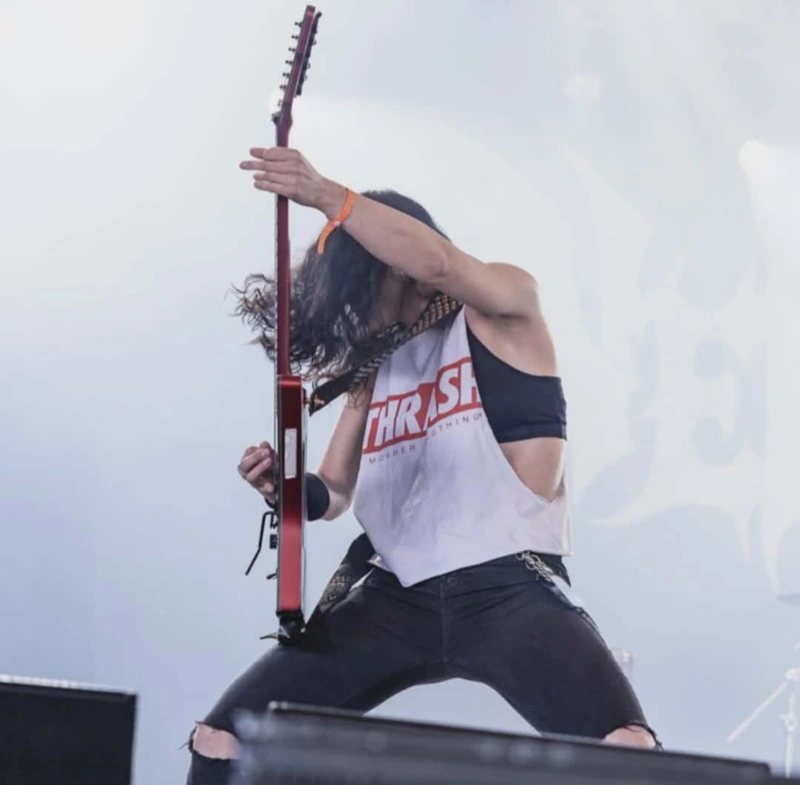
By joining Nervosa, you immediately found yourself in a band with a strong identity and global presence. What was the process of integrating and creating within an already “tight-knit” band like for you?
In general, this is what I wanted—to take the next step. The fact that the band already had recognition, albums, worldwide tours, and many years of experience helped me mature faster. I was thrown straight into the deep end. Where I used to do small tours in Greece, I suddenly found myself on the other side of the world on a two-month tour, and that helped me take everything more seriously. You enter a different mindset. You see things differently—you might be playing every night, with 30 shows ahead of you and no breaks. You start being responsible for yourself both as a musician and as a person. Of course, through all this you need to maintain stability. It’s not just about touring—when you come back home, sometimes the work we do there is more stressful and demanding than the tour itself, because you’re working on things that concern the future. Every time we return, we think about the next steps and work on the next album, which might be released in two years, and that means countless hours. So you need to adopt a mindset where you take care of everything. The fact that the band had so much more experience than me was something I loved—it was definitely a challenge and exactly what I wanted, so there was no way I’d step back. Even though everything started immediately, I feel better about it because it helped me. For example, I started with a two-month tour in Latin America—once you’ve gone through that, other things come easier!
The new album was written during a period of constant touring and intense pace of life. How does that affect songwriting and creativity? Are ideas born more easily on the road or in the studio?
The truth is this album was written in many places and at different times. Some songs were written much earlier, maybe even in 2024. Every time we returned from tour, we knew we had to work on the next material. For one and a half to two years, touring was continuous, but we knew we had to release an album within the next three years, so we worked in between. That was a decision we made—we didn’t want to leave a four-year gap. Many times we discussed things while on tour or even finished a song while still touring, during a one- or two-day break. Whether it’s harder or easier in the studio or on tour depends. On one hand, it was good that we had time together and were constantly brainstorming. We talked and analyzed ideas, themes, concepts—everything. It was easier to have all that prepared. Of course, when you’re in the studio things are calmer, but sometimes stress works the opposite way—for example, when you have two days to finish something. It makes you extremely focused and helped ideas come and things fall into place immediately. For me, it was strange, of course, but I’m open to any challenge. Since we had ideas and were all on the same page, I wanted it and was looking forward to it. It was one of the most stressful years.
You’ve played live in countries and continents that for many musicians seem like an unattainable dream. Is there a concert or audience that truly marked you and reminded you why you live this life?
Of course there are moments—quite a few—that remind you why you do this and why you continue despite the difficulties and obstacles you encounter on the road. One of those memories was a festival we played in China in April ’25. It was a strangely beautiful experience. We had no information about the festival, and when we arrived, it turned out to be a huge event. From the moment we started playing, chaos broke out in front of the stage! We didn’t know what to expect, nor could the audience know what to expect. It was a unique, strange, and beautiful day. Also, the Hammersonic festival in Indonesia was another unforgettable experience. In general, I think every continent and every country has its own character. We love the audience in Latin America—they give it their all. Europe has different characteristics. In the U.S., we played one of our best shows ever in clubs in Brooklyn and New Jersey—we couldn’t believe it. Those were definitely among our best concerts.
Before and alongside Nervosa, you’ve been involved in different projects and collaborations. How important is it for you to keep multiple creative paths open instead of just one?
Yes, before I had other bands and projects, and I still do, but now there isn’t enough time for everything to run simultaneously since Nervosa is the priority with an intense schedule. Still, I believe it’s very important for musicians to have other things going on in parallel, so you can step away, listen to and experience something different. Taking a break from it all is good for you and for the band. You come back with more influences. It might sound strange if you ask how blues or jazz could help me write and play metal. And yet, the more influences you have and the more you allow yourself to experiment and explore other genres, the better it is for what you mainly do.
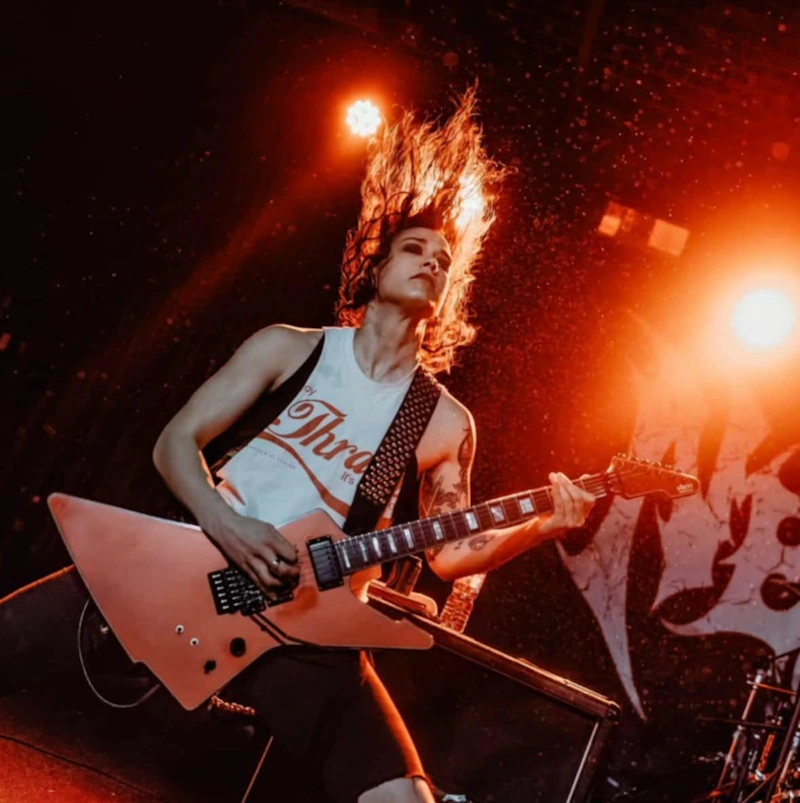
You started from the Greek metal scene and now you’re part of one of the most recognized thrash metal bands worldwide. Looking back, what do you consider the most defining step in this journey?
I think there are many steps that lead you to the moment when everything begins. One was when we started playing bigger shows with Daffodil—that’s when I realized this is what I want to do, and I said I wouldn’t step back. Also, the moment the proposal came and I accepted the challenge. Everything started outside Greece with a big tour in Latin America, which was one of the greatest lessons I could have had. Day one: let’s go! From 0 to 100, accepting such a challenge—it was definitely huge.
With Nervosa’s new album approaching, what excites you the most about this release? Is there any element of the album you particularly look forward to presenting live?
Yes, I truly can’t wait for the release—April feels far away! We’re very happy we were able to release the first single and show people what we’re preparing, and we’re extremely happy with the response. I’m looking forward to playing the new songs live because it’s a challenge for us. In recent years, we’ve been playing older songs or tracks from the previous album over and over, and you reach a point where you say, “OK, I love these songs, but let’s move on.” The challenge of delivering live what you’ve recorded—I’m really looking forward to that. You’re always eager to see the audience’s reaction when you play new material for the first time, because sometimes you think, “This will be great live,” but maybe it doesn’t work that well for some reason. That’s an extra anxiety and curiosity.
Alongside Nervosa, you released your personal EP One of Those Days, where a more personal side of you as a musician is revealed. What drove you to create this material, and how different did it feel writing something that bears exclusively your own signature?
The truth is I started composing the EP before joining Nervosa—the release just happened to be close to when I joined. What made me do it was that I had started collecting many ideas that didn’t fit into any of the bands I was playing in, and I didn’t want to leave them aside. I didn’t have in mind to form a band—I saw it as a studio project. I like to stay active, so in between everything I worked on it. It also helped me mature, because all the decisions—about composition or anything related to the EP—had to come from me. I had to be responsible for everything, which I hadn’t done before. I was always in bands where there was discussion with others, etc. This process helped me mature and explore more. It opened my eyes in many areas, not just playing guitar and writing my own parts.
With so many live shows, travels, studio sessions, and projects running simultaneously, if you had to describe this current phase of your life with one word or image, what would it be? And to close, the floor is yours—would you like to send a message or shout-out to MOSΗ and everyone reading us?
In general, it’s a dream I’ve had since day one, since I first picked up a guitar. Of course, that doesn’t come on its own, it takes tons of work, and work that never stops. It’s a continuous process that can be difficult, with obstacles along the way, but in the end there’s always a moment when you say it was worth even the smallest thing.
Thank you very much to mosh for this interview, and stay tuned because we have more things coming soon, leading up to April when the new album will be released!



Σχετικά θέματα


Created and Developed by Mosh Crew